

Working in the cold: what does research say about manual dexterity, comfort and heated clothing?
Share
Anyone who regularly works outdoors knows that cold is more than just uncomfortable. Cold hands make simple tasks noticeably more difficult. Temperature, wind, moisture, exertion, working time and fine motor skills all affect how demanding cold conditions become. Heated clothing can provide additional personal comfort, but it does not replace a risk assessment or prescribed protective equipment.
This article explores what research says about working in the cold and what heated clothing can and cannot offer in these conditions.
Cold and manual dexterity
TNO researcher Hein Daanen investigated how cold and wind affect manual dexterity. Participants were exposed under controlled conditions to temperatures of 0, -10 and -20 °C, combined with different wind speeds. The measurements included finger dexterity, manual dexterity and grip strength. The researcher found a clear relationship between the combination of cold, wind and exposure time and a decline in manual performance.
Studies on cold do not always find the same effects because gloves, temperature, exposure time and tasks vary. A randomised trial involving 22 participants at 5 °C found that directly heating the hands kept the fingers warmer and limited the decline in a manual dexterity test.
This is relevant to technicians, installers and logistics workers who use tools, assemble components or operate equipment. Above all, it demonstrates the importance of task-specific hand protection. A heated vest does not replace suitable work gloves.
Temperature alone does not tell the whole story
When working outdoors, the thermometer does not tell you everything. Wind causes the body to lose heat more quickly. Precipitation, clothing, activity and exposure time also play a part. Protection against cold should therefore always be considered as a complete system.
Cold-weather tasks vary considerably
Research into occupational exposure to cold showed that the required level of clothing insulation varied by activity. Even when the assessed protective equipment generally provided sufficient protection, thermal discomfort could not be ruled out entirely.
A study of Arctic mining found that workers adapted their clothing according to time spent outdoors, temperature, wind, moisture and personal sensitivity. These conditions are more extreme than typical outdoor work in the Netherlands and Belgium, but the lesson is still relevant: one standard set of clothing is not suitable for every task.
What can torso heating add?
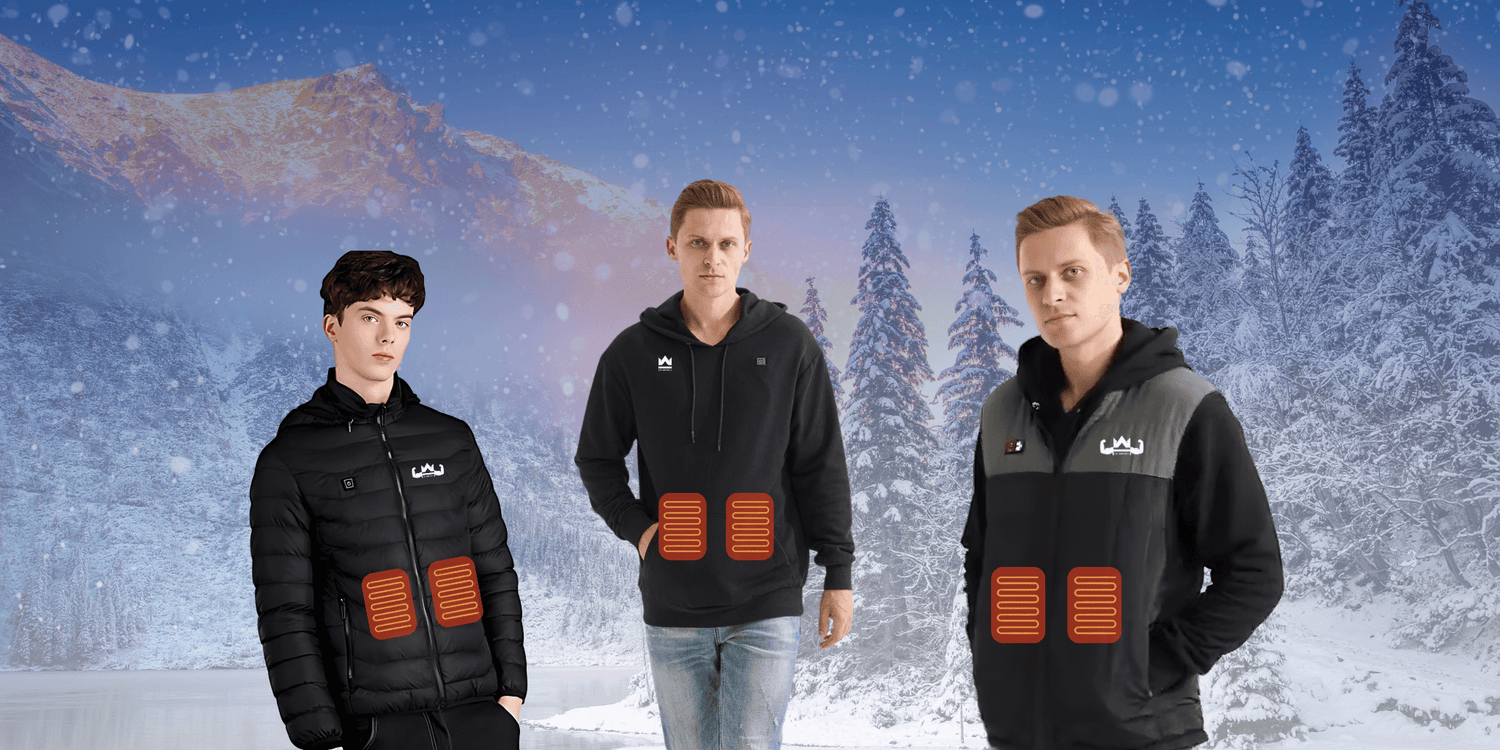
Small laboratory studies of electrically heated vests indicate that torso heating can improve overall perceptions of warmth. In one trial conducted in extreme cold (-15 °C), torso heating was also associated with warmer fingers and improved hand comfort. The study groups were small and the conditions were specific. You can read more about these studies in does heated clothing work?
During active work, a low setting may be sufficient. When waiting, supervising or carrying out less intensive work, additional warmth may feel more comfortable.
Why a heated vest is practical for teams
A heated vest provides warmth around the torso while leaving the arms free. This makes it easy to combine with existing workwear and a work jacket. It may be suitable for technicians, construction workers, security staff, logistics workers, field service employees, event staff and delivery drivers.
The precise choice of clothing still depends on the work being carried out and the risks in the workplace.
Warmth is not a safety measure in itself
Thermal comfort is not the same as protection against cold-related occupational risks. Heated clothing does not replace prescribed protective clothing, work instructions, rest breaks or other measures identified through a risk assessment. It is an additional layer of warmth within a broader cold-weather policy.
Practical checklist for employers
- Assess the temperature, wind, moisture and duration for each task.
- Consider the intensity of the work and periods of inactivity.
- Retain all required protective equipment and suitable outer layers.
- Make sizing, instructions, charging and washing practical to manage.
- Allow employees to adjust the heat themselves and report discomfort.
- Test the clothing in your own working environment before rolling it out more widely.
Conclusion
Cold and wind can noticeably reduce manual dexterity and comfort. Research supports the view that personal heating can improve comfort in cold conditions, but for outdoor work it remains an addition rather than a standalone safety measure. For businesses, a small trial with one team in their own working environment is the best first step.
Does your team regularly work outdoors or in cold conditions? Request a quote through the business enquiry page for the heated vest. Business orders start from 10 units.
Research sources
- Daanen, H.A. Manual performance deterioration in the cold estimated using the wind chill equivalent temperature. Industrial Health (2009). PubMed
- The application of heating film to hands reduces the decline in manual dexterity performance. European Journal of Applied Physiology (2024). DOI 10.1007/s00421-024-05482-7
- Evaluation of the efficacy of personal protective equipment against occupational exposure to cold. Revista Brasileira de Medicina do Trabalho (2019). PubMed
- Thermal comfort sustained by cold protective clothing in Arctic open-pit mining. Industrial Health (2017). PubMed
- Brajkovic, D., Ducharme, M.B. and Frim, J. Influence of localized auxiliary heating on hand comfort during cold exposure. Journal of Applied Physiology (1998). PubMed
- Li, S., Jia, X., Cao, B. and Zhu, Y. Improvement of thermal perceptions and physiological responses using torso heating under short-term cold exposure. Science of the Total Environment (2023). PubMed
The studies describe effects under specific experimental conditions and are not tests of KingsPower products.