

Working in the cold: what happens to manual dexterity and comfort?
Share
Anyone who regularly works outdoors knows that cold is more than uncomfortable. Cold hands can make simple tasks noticeably more difficult.
This effect has also been studied.
Cold and manual dexterity
TNO researcher Hein Daanen studied how cold and wind affect manual performance. Participants were exposed under controlled conditions to temperatures of 0, -10 and -20 °C combined with different wind speeds.
Finger dexterity, manual dexterity and grip strength were among the measurements. The researchers found a clear relationship between cold, wind, exposure duration and declining manual performance.
This is relevant for work involving tools, assembly, equipment operation or prolonged exposure outdoors.
Temperature alone does not tell the whole story
For outdoor work, the thermometer is only part of the picture. Wind can remove heat from the body more quickly, while precipitation, clothing, activity level and exposure duration also matter.
Protection against cold should therefore be considered as a complete system. A heated vest cannot make unsuitable workwear appropriate for extreme conditions.
Start with normal protection
Suitable workwear remains the foundation. This can include insulating layers and appropriate wind and rain protection. Depending on the job, specific personal protective equipment may also be required.
Heated clothing can be added as an extra comfort layer. A low setting may be enough during active work, while more warmth may feel useful when waiting, supervising or performing less intensive tasks.
Why a heated vest can be practical
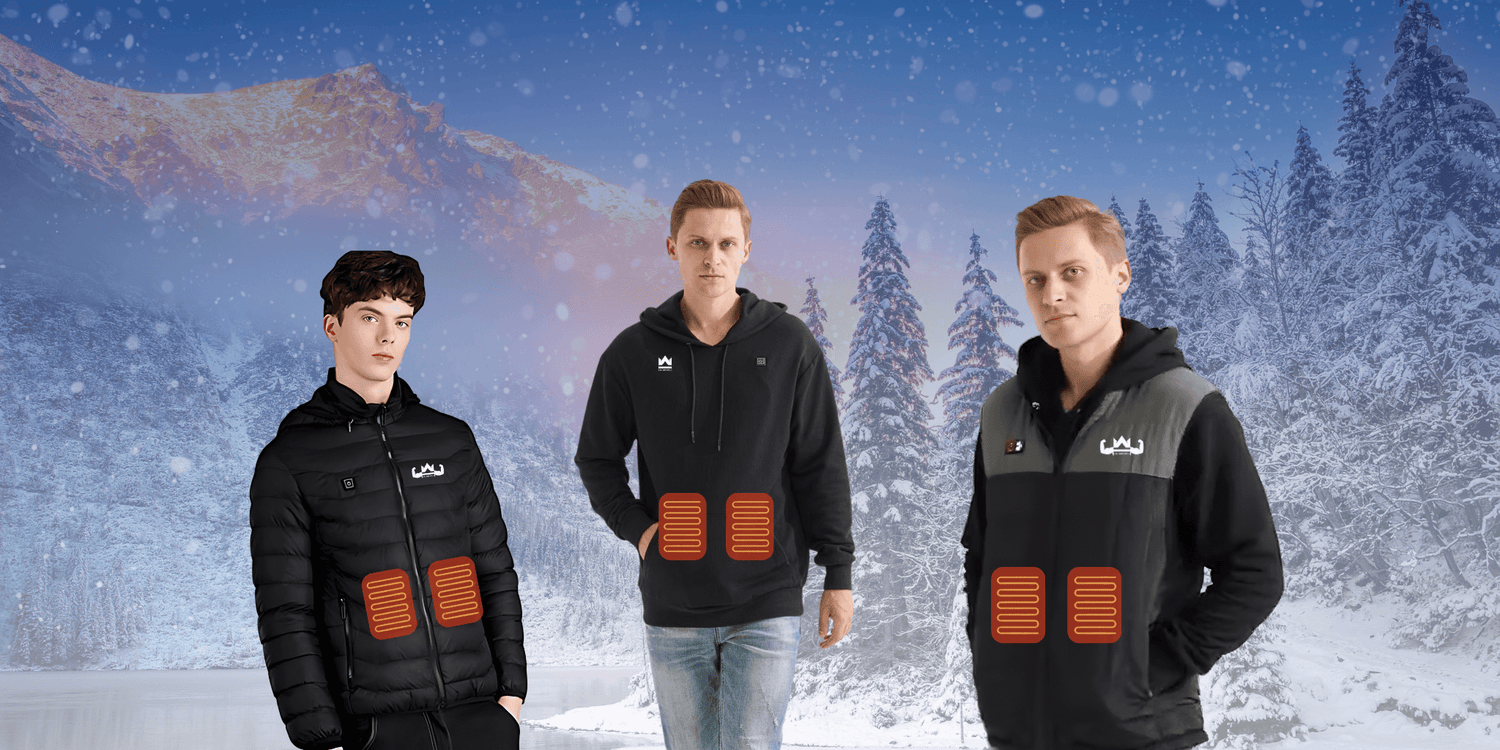
For business use, a heated vest is particularly practical because it provides additional warmth around the torso while leaving the arms relatively free. This makes it easier to combine with existing workwear.
Examples include technicians, construction workers, security staff, logistics employees, field-service teams, event staff and delivery workers.
The exact clothing choice still depends on the work and the risks present at the workplace.
Warmth is not a safety measure by itself
Thermal comfort is not the same as protection against occupational risks related to cold.
Heated clothing should therefore not replace required protective clothing, workplace instructions, rest breaks or other measures resulting from a risk assessment. It is an additional source of warmth.
Heated clothing for a team
For companies, heated clothing becomes particularly relevant when several employees experience similar cold conditions. Fit, power-bank capacity, runtime, maintenance and clothing combinations can then be coordinated in advance.
KingsPower also supplies heated clothing to businesses. Companies requiring larger quantities can request a tailored quotation.
Does your team regularly work outdoors or in cold conditions? Contact KingsPower about business supply options.
Source
Study on cold, wind chill and manual performance.
The study describes effects under specific experimental conditions and is not a test of KingsPower products.